
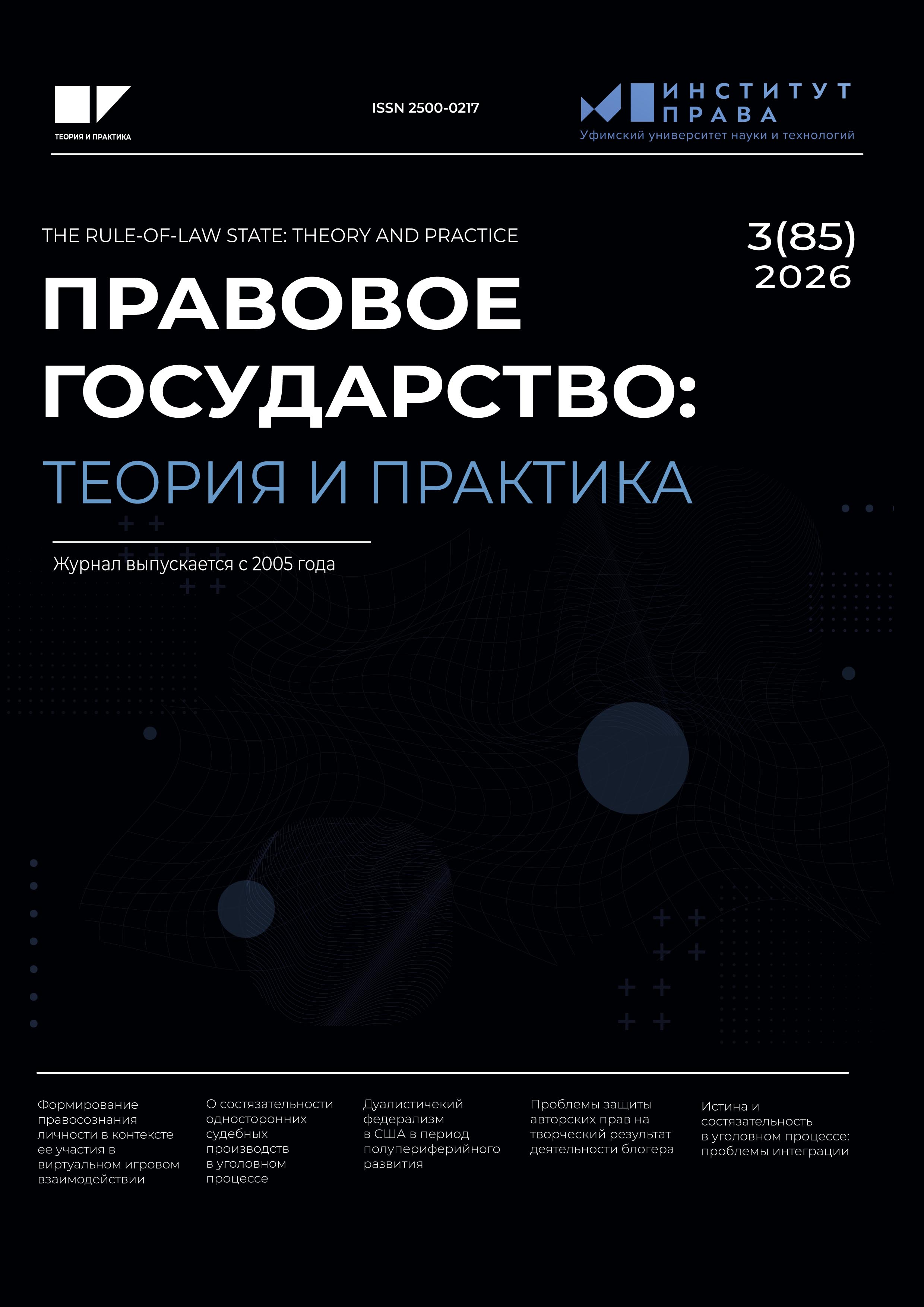
DUAL FEDERALISM IN THE UNITED STATES DURING SEMI-PERIPHERAL DEVELOPMENT
DOI:
https://doi.org/10.33184/pravgos-2026.3.1Keywords:
federalism, world-systems analysis, US state and law, American federalism, semi-peripheryAbstract
The development of the US state structure, along with the gradual transformation of the legal system and public administration mechanisms, was driven by the need to create an optimal model of power distribution in the interest of the economy and large corporations, which ultimately contributed to changing the country’s position in the modern world. Analyzing the transformation of American federalism from the perspective of the world-systems approach holds significant scholarly interest, as it clarifies the reasons behind shifts in federal and state powers following the Civil War. Purposes: to identify the patterns of change in the scope of authority between the federal government and the states, including within the economic sphere, as the United States moved along the “core-periphery” axis of the modern world-economy following the Civil War, as well as to examine the role of the U.S. Supreme Court in shaping the model of dual federalism. Methods: world-systems analysis allowed for identifying the conceptual link between the strengthening of federal authority and state economic interests; the historical-legal method was used to study the evolution of federal relations, while the comparative legal method enabled a comparison of the scope of federal and state powers before and after the Civil War. Results: the United States has evolved from a confederation with absolute state autonomy into a centralized state characterized by a developed system of dual federalism. When viewed through the lens of world-systems analysis, a clear pattern emerges: the centralization of authority within the federal government correlates with the country’s ascent along the “core-periphery” axis of the capitalist world-system. The necessity of transferring economic and social regulatory powers to the federal government was driven by large-scale capital’s demand for uniform legal regulation, the protection of goods in both national and foreign markets, stimulating the migration of skilled labor, and safeguarding monopolies. Throughout this process, the Supreme Court maintained a contradictory position, preserving a relative balance of powers. Nevertheless, by the end of the 19th century, the judicial system also came to support the centralization of power in the sphere of economic relations.
References
Лафитский В.И. Конституционный строй США / В.И. Лафитский. – Москва : Институт законодательства и сравнительного правоведения при Правительстве РФ, 2007. – 320 с.
Тихонов М.С. Экономические основы американского федерализма : дис. … канд. юрид. наук : 12.00.02 / М.С. Тихонов. – Москва, 2002. – 184 с.
Сидоров О.А. Судебный федерализм США: основные тенденции развития / О.А. Сидоров // Пробелы в российском законодательстве. – 2011. – № 2. – С. 9–12.
Сидоров О.А. Модернизация американского дуалистического федерализма (историко-правовой аспект) / О.А. Сидоров // Марийский юридический вестник. – 2008. – № 6. – С. 13–20.
Гуляков Д.В. Становление и развитие федерализма: сравнительное историко-правовое исследование основных федеративных моделей (конец XVIII – начало XXII века) : автореф. дис. … д-ра юрид. наук : 12.00.02 / Д.В. Гуляков. – Саратов, 2022. – 59 c.
Munro W.B. The Government of the United States: national states and local / W.B. Munro. – New York : The Macmillan Co., 1946. – 887 p.
Латыпова Н.С. Естественные права человека в контексте XIII, XIV, XV поправок к конституции США / Н.С. Латыпова // Наука молодых – будущее России : сборник научных статей 3-й Международной научной конференции перспективных разработок молодых ученых, Курск, 11–12 декабря 2018 г. : в 6 т. – Курск : Университетская книга, 2018. – Т. 3. – С. 221–224.
Downloads
Published
How to Cite
Issue
Section
License

This work is licensed under a Creative Commons Attribution 4.0 International License.
Authors retain copyright and grant the journal right of first publication with the work simultaneously licensed under a Creative Commons Attribution License that allows others to copy and redistribute the material in any medium or format; remix, transform, and build upon the material for any purpose, even commercially, unless appropriate credit is given, a link to the license is provided, and all made changes are indicated.


