
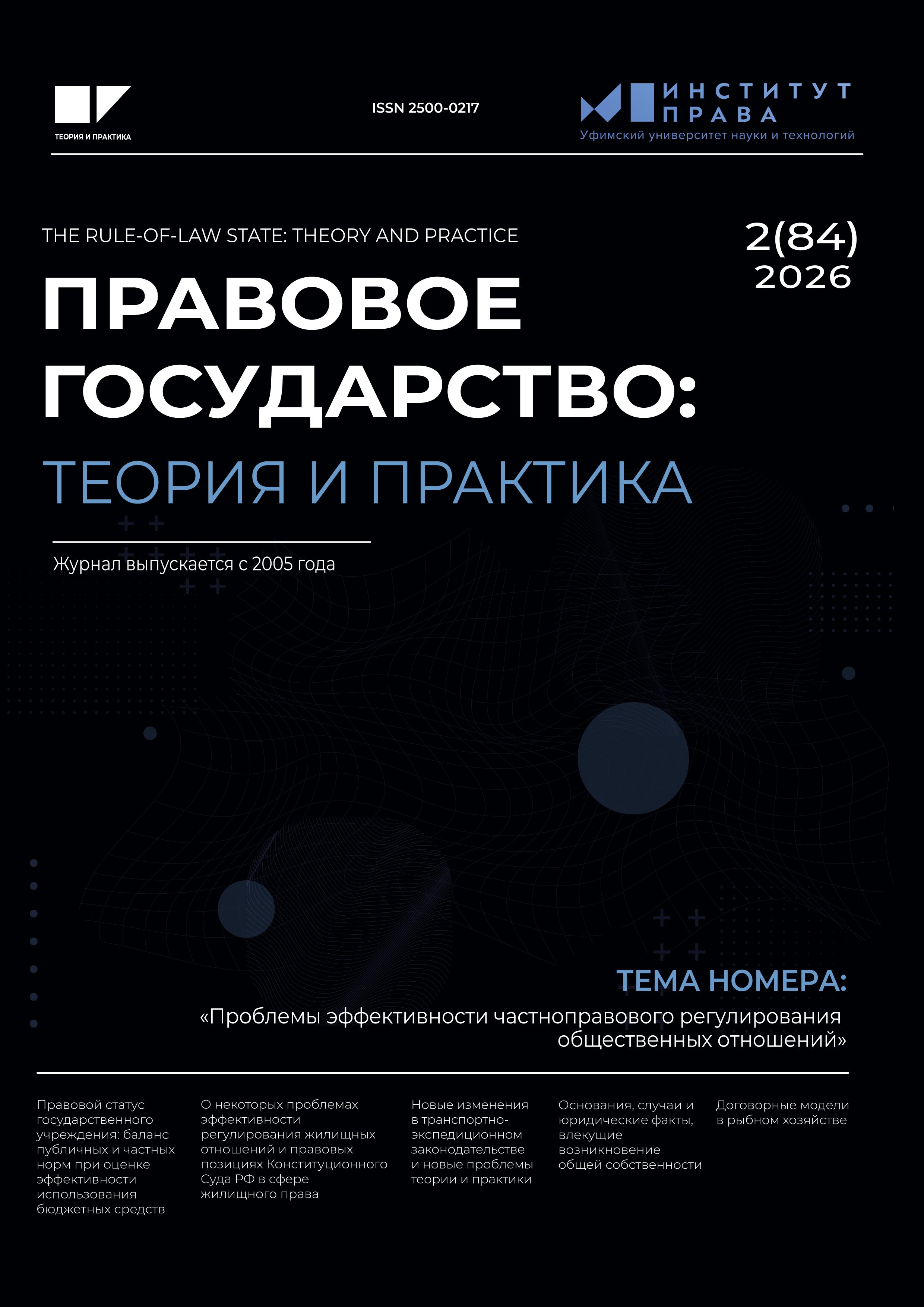
SOME ISSUES OF THE EFFECTIVENESS OF REGULATING HOUSING RELATIONS AND THE LEGAL POSITIONS OF THE CONSTITUTIONAL COURT OF THE RUSSIAN FEDERATION IN THE SPHERE OF HOUSING LAW
DOI:
https://doi.org/10.33184/pravgos-2026.2.7Keywords:
housing law, legal positions of the Constitutional Court of the Russian Federation, privatization of residential premises, residential premises, rental of residential premises, ownership and other property rights to residential premisesAbstract
Despite the rather impressive volume of housing legislation, it is impossible to comprehend modern regulation in this area, let alone resolve specific housing disputes, without considering judicial practice. The activities of the Constitutional Court of the Russian Federation are of particular significance in this regard. The purpose of the research is to identify different types of legal positions of the Constitutional Court of the Russian Federation in the field of housing law and to assess the effectiveness of their regulatory impact. The study is based on the use of the dialectical method, logical methods such as analysis, synthesis, and deduction, as well as the systemic method. The dialectical method is used to examine the formation of the Constitutional Court’s legal positions, identifying the strengths and weaknesses of their impact on housing relations; analysis and deduction are employed to identify specific techniques for formulating legal positions within the existing material of the Constitutional Court’s practice on housing disputes; synthesis and a systemic approach are used to present types of legal positions in a generalized form as elements of a unified system, revealing the role and significance of these elements for the regulation of housing relations as a whole. Research results: the article identifies and analyzes positions aimed at revealing the constitutional meaning of norms without declaring them unconstitutional; at recognizing norms as unconstitutional and inapplicable without establishing substitute regulation; at recognizing norms as unconstitutional while maintaining their effect without establishing substitute regulation; and at recognizing norms as unconstitutional with the establishment of substitute regulation. The problems of the effectiveness of each of these types of legal positions are identified.
References
Гражданское право: учебник : в 2 т. / под ред. Б.М. Гонгало. – Москва : Статут, 2023. – Т. 1. – 622 с.
Васьковский Е.В. Цивилистическая методология. Ч. I. Учение о толковании и применении гражданских законов / Е.В. Васьковский. – Одесса : «Экономическая» типография, 1901. – 376 с.
Гражданское право : учебник : в 2 т. / под ред. Б.М. Гонгало. – Москва : Статут, 2023. – Т. 2. – 606 с.
Гонгало Б.М. Развитие кодификации жилищного права / Б.М. Гонгало, П.В. Крашенинников // Кодификация российского частного права 2019 / под ред. Д.А. Медведева. – Москва : Статут, 2019. – С. 330–377.
Гонгало Б.М. Трансформация недопустимости обращения взыскания на единственное жилое помещение, пригодное для проживания, в право на сохранение за гражданином достаточного (достойного) жилища / Б.М. Гонгало, М.В. Бандо // Проблемы современного гражданского права : сборник статей памяти В.С. Ема (к 70-летию со дня рождения) / отв. ред. проф. Е.А. Суханов. – Москва : Статут, 2021. – С. 194–214.
Downloads
Published
How to Cite
Issue
Section
License

This work is licensed under a Creative Commons Attribution 4.0 International License.
Authors retain copyright and grant the journal right of first publication with the work simultaneously licensed under a Creative Commons Attribution License that allows others to copy and redistribute the material in any medium or format; remix, transform, and build upon the material for any purpose, even commercially, unless appropriate credit is given, a link to the license is provided, and all made changes are indicated.


